
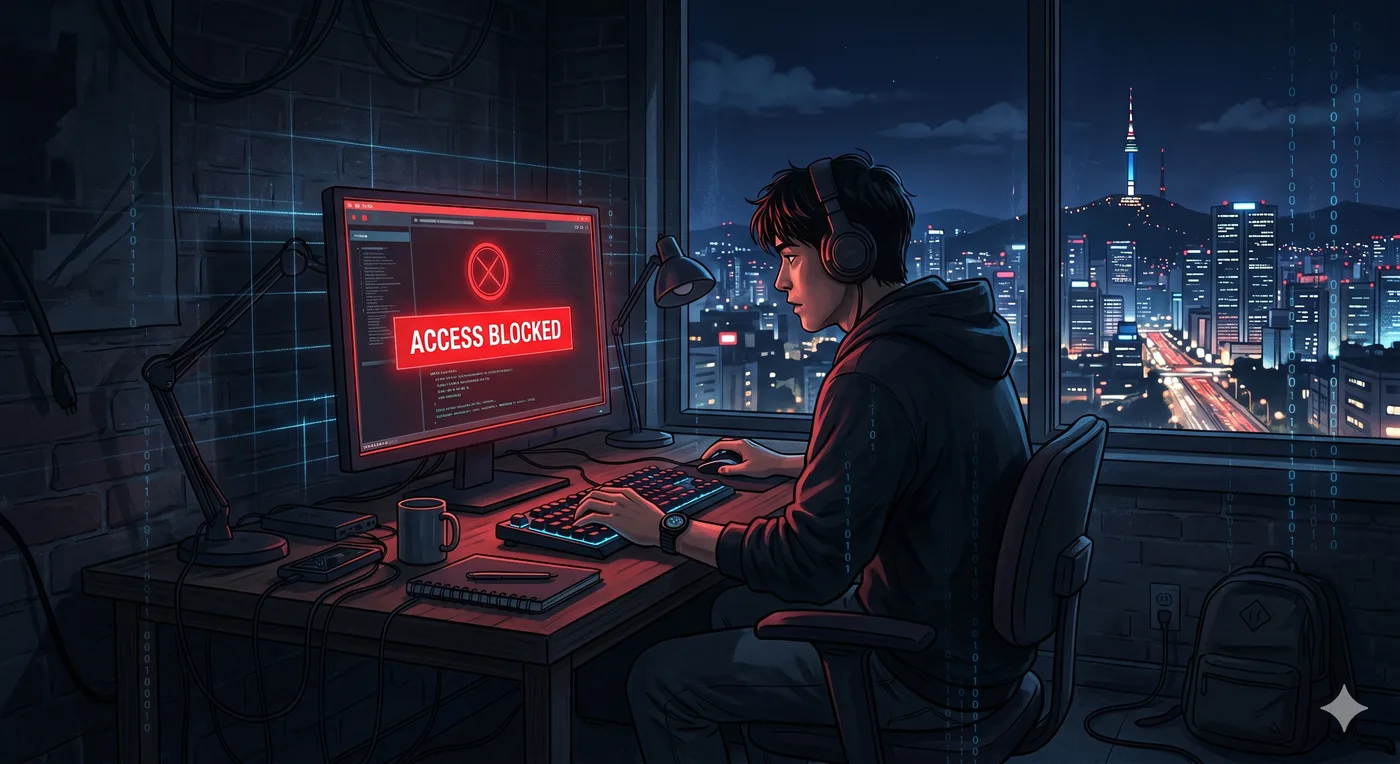
South Korea has one of the fastest internet connections in the world. But behind that speed sits one of the most aggressive content filtering systems in any democratic country — and in 2026, it just got significantly stronger.
What Changed in 2026
The Korea Media and Communications Commission requested Cloudflare's cooperation in blocking access to a wide range of foreign websites back in September 2025. After nearly eight months of restructuring, those blocks went live on May 1, 2026 — and the scale is massive.
Cloudflare is now actively blocking foreign sites in Korea under the new emergency copyright blocking framework. Anyone who tries to visit a blocked site sees: "Government-ordered blocking under the Korea Network Act."
Sites like Iwara and F95Zone went down overnight. Cloudflare handles roughly 20% of global web traffic — so this isn't a minor DNS trick. It's infrastructure-level blocking.
The Full 2026 Censorship Timeline
This is what's already happened — and what's coming:
- April 1 — AI-powered deepfake and sexual exploitation detection system launched (24/7 automated scanning)
- May 1 — Cloudflare begins blocking Korean IPs from accessing government-designated illegal sites (F95, Iwara, Melonbooks, etc.)
- May 11 — Emergency Copyright Site Blocking Law takes effect. The Minister of Culture can now directly order ISPs to block sites without going through the usual review process
- July 1 — AI filtering expands to ALL images on every Korean community platform and SNS. Every image upload will be scanned before it goes live
- July 7 — Fake News Elimination Law takes effect. The KCSC gains power to order content deletion; site operators face fines for non-compliance
- August 11 — Punitive damages of up to 5x the original amount for habitual copyright infringement, plus increased criminal penalties
The July 1 expansion is the one Korean communities are most alarmed about. Every image uploaded to Korean platforms — not just illegal content sites — will pass through AI scanning. This adds server load, slows uploads, and degrades performance across the board.
Is VPN Still Legal and Safe in Korea?
Yes — and this is the biggest point of confusion right now.
Many Koreans believe this is a "VPN crackdown law." It is not. The laws target site operators and CDN providers — not individual users. VPN usage by individuals is not criminalized by any of these new laws.
The confusion spread because headlines used phrases like "mandatory access blocking technology" — which people interpreted as targeting VPN users. The actual law mandates that internet infrastructure providers (like Cloudflare) block illegal content at the network level. Using a VPN as an individual to bypass that blocking is a separate matter entirely, and remains in a legal grey area — not an outright crime.
What Actually Works to Bypass This
VPN (Most Reliable for Users)
A VPN routes your traffic through a server outside Korea, bypassing both DNS filtering and Cloudflare's infrastructure-level blocks.
How to use it:
- Sign up for a reputable paid VPN — NordVPN, Surfshark, and Mullvad are well-regarded options
- Connect to a server outside Korea (Japan works well for speed)
- Browse freely
Free VPNs and Cloudflare's own WARP are increasingly unreliable — users have reported WARP still showing the block page. A paid VPN with active obfuscation is strongly recommended.
Download VODs Before They Disappear
Even with a VPN, you're dependent on the platform staying available. The safest approach — especially for streaming fans — is to download VODs you care about before they get caught in a takedown.
Vodloader is built for exactly this. It lets you download and save VODs from Korean streaming platforms before they're gone. No Korean account needed. Works from anywhere in the world.
If a platform gets blocked or content gets deleted, your downloaded copy is unaffected.
Why This Is Different From Before
Old blocking method: Government identifies a site → ISP shows a warning page → user changes DNS and bypasses it.
New method: Government requests Cloudflare to block at the infrastructure level → Cloudflare checks your IP → Korean IP gets HTTP 451 error regardless of DNS settings.
The analogy Koreans are using: before, they removed the nameplate from the door. Now they've blocked the road itself.
The Bigger Picture
What's different in 2026 is the automation and the scale. The July 1 image scanning expansion means every domestic Korean platform will need expensive AI scanning servers — estimated at tens of millions of won in setup costs, plus ongoing maintenance. Smaller communities can't afford this. Some will shut down.
One major Korean platform already shut down on May 3 — its operator cited 170,000 member resignations within 48 hours and the loss of all advertisers following media coverage of the crackdown.
Civil society groups like OpenNet Korea have filed objections, arguing the measures have "characteristics of administrative censorship" and may be unconstitutional. The concern isn't just about illegal content — it's about what infrastructure-level blocking means for legal content that gets caught in the crossfire.
Quick Reference
| Method | Works Against New Blocking | Notes |
|---|---|---|
| DNS change only | No | No longer effective |
| Cloudflare WARP | No | Users report same block page |
| Free VPN | Unreliable | May not bypass Cloudflare blocks |
| Paid VPN (NordVPN etc.) | Yes | Best option for users |
| Download with Vodloader | Yes | Best for streaming content |
The internet in Korea is changing fast. Whether you're a resident or a fan abroad, having a plan to access and preserve content you care about is more important than ever.